If I said waves, what appears in your mind? The ocean? Probally, but I am talking about other waves too. There is a whole world of waves, and they all fall under two catagories, transversal waves and longitudinal waves. And you can break those waves up into two other catagories, mechanical waves, waves that require a medium to travel through, and electromagnetic waves do not need a medium to travel through.Transversal waves move at right angles to the direction in which all waves travel. And longitudinal waves move prallel to the direction in which the waves travel.
The Anatomy of a Transversal Wave
Transversal waves comes from the word transverse, which means across. In a transversal waves, the particles of the waves move across traveling in the direction in which the wave travels. The rest point of a transversal wave is point when the medium is not moving or is still. The amplitude of a transversal wave is determined by how high or low the wave is from its rest point. The crest of a wave is the highest part of a wave. The trough of a wave is the lowest part of a wave. From the rest point to the crest is a positive amplitude. From the rest point to the trough is a negative amplitude. From crest to crest or trough to trough measures a wavelength. The greater the energy disturbance is, the greater the frequency of the wave is.
If you had a rope, and some one were to be holding one end of the rope and you held the other, that rope would be in its rest point. If you grasped the rope in one hand and you flicked is once per second, your partner wouldn't be able to hold the rope still. Why? Because the energy you inflicted on the rope, travels down the rope and enters your partner. Even if you flick your hand the slightest amount, your partner still wont be able to keep their hand still.
The Anatomy of a Longitudinal Wave
A longitudinal wave is a wave which moves the medium parallel to the direction in which the wave travels. The best example of a longitudinal wave is a slinky. If you hold onto one end of the slinky, and push and pull with the other end of the slinky, you can see "pulses" traveling down the slinky. The "pulses" are compressions. Compressions mean what they sound like. Compressions are parts where the coils are closed together, or are compressed. The parts of the slinky that is spread out are called rarefractions. One wave length on a longitudinal wave is measured from the end of one compression, to the beginning of another.
If you took a slinky and placed it on the floor with you partner holding one end of the toy, and you pulled back and pushed foward, you can see the coils compress and rarefract. But unlike the rope scenerio, your partner will be able to hold the slinky still. Why? Because only some of the energy will get transfered into your partner. Some will turn into heat energy. And some will reflect back. Its like if you threw a bouncy ball at the wall. You throw it with a certain amount of energy, but when it comes back its weaker, thats because some of the energy dissapated from the object.
Saturday, May 14, 2011

Thursday, February 10, 2011
The Toothpick Fish Lab
Many labs resemble real life situations. The toothpick fish lab could resemble a stream ecosystem. This lab show how adaptation occurs in the wild and how changing and ecosystem could push a species too far.
Data Analysis:
(G) The green allele is dominant in all case
Combination's that make a green fish-GG, Gr, Gy
(r) The red allele is recessive to the green allele and incomplete to the yellow allele
Combination's that make a red fish-rr
(y) The yellow allele is recessive to the green allele and incomplete to the red allele
Combination's that make a yellow fish-yy
Combination's that make an orange fish-ry
In this environment, the yellow fish die due to the fact that they cannot blend into the plants or the red and orange rocks. The other fish seem to steer past predators long enough so that they reproduce.
F1 Generation
In the F1 generation, all alleles and fish are there. There has been no fish fatalities.
6/12 fish are green
1/12 fish are red
1/12 fish are yellow
4/12 fish are orange
The yellow fish are removed because that resembles them dieing in the wild. Now there are two yellow alleles that have been removed from the gene pool and one less fish possibility. The yellow alleles are beginning to slowly disappear.
F2 Generation
In the F2 generation, there are two less yellow alleles, and one less fish. Now there can be only eleven fish in the stream. One fish has died.
5/11 fish are green
0/11 fish are red
0/11 fish are yellow
6/11 fish are orange
In this generation there are no yellow fish, thus that means there are no fish removed. The yellow alleles are distributed in the green and orange fish. The red alleles are also distributed in the green and orange fish.
F3 Generation
In the F3 generation, there are still eleven fish total. There has been no fatalities.
6/11 fish are green
2/11 fish are red
1/11 fish are yellow
2/11 fish are orange
The yellow fish is removed once again and there are two less yellow alleles in the gene pool. Even though we have been removing all of the yellow fish, the alleles have not disappeared completely. However, the alleles are disappearing and in a few more generations, they will disappear completely. The population also has been decreasing due to yellow fish removal. In the F3 generation, there is one less fish than in the F1 generation.
F4 Generation
In the F4 generation, the yellow fish has been removed and there are two less alleles in the gene pool. There are only enough alleles to create ten fish. There has been one fish death.
7/10 fish are green
1/10 fish are red
0/10 fish are yellow
2/10 fish are orange
There are no yellow fish, thus no yellow fish are removed. The yellow alleles have been distributed into the green and orange fishes.
Data Analysis:
(G) The green allele is dominant in all case
Combination's that make a green fish-GG, Gr, Gy
(r) The red allele is recessive to the green allele and incomplete to the yellow allele
Combination's that make a red fish-rr
(y) The yellow allele is recessive to the green allele and incomplete to the red allele
Combination's that make a yellow fish-yy
Combination's that make an orange fish-ry
In this environment, the yellow fish die due to the fact that they cannot blend into the plants or the red and orange rocks. The other fish seem to steer past predators long enough so that they reproduce.
F1 Generation
In the F1 generation, all alleles and fish are there. There has been no fish fatalities.
6/12 fish are green
1/12 fish are red
1/12 fish are yellow
4/12 fish are orange
The yellow fish are removed because that resembles them dieing in the wild. Now there are two yellow alleles that have been removed from the gene pool and one less fish possibility. The yellow alleles are beginning to slowly disappear.
F2 Generation
In the F2 generation, there are two less yellow alleles, and one less fish. Now there can be only eleven fish in the stream. One fish has died.
5/11 fish are green
0/11 fish are red
0/11 fish are yellow
6/11 fish are orange
In this generation there are no yellow fish, thus that means there are no fish removed. The yellow alleles are distributed in the green and orange fish. The red alleles are also distributed in the green and orange fish.
F3 Generation
In the F3 generation, there are still eleven fish total. There has been no fatalities.
6/11 fish are green
2/11 fish are red
1/11 fish are yellow
2/11 fish are orange
The yellow fish is removed once again and there are two less yellow alleles in the gene pool. Even though we have been removing all of the yellow fish, the alleles have not disappeared completely. However, the alleles are disappearing and in a few more generations, they will disappear completely. The population also has been decreasing due to yellow fish removal. In the F3 generation, there is one less fish than in the F1 generation.
F4 Generation
In the F4 generation, the yellow fish has been removed and there are two less alleles in the gene pool. There are only enough alleles to create ten fish. There has been one fish death.
7/10 fish are green
1/10 fish are red
0/10 fish are yellow
2/10 fish are orange
There are no yellow fish, thus no yellow fish are removed. The yellow alleles have been distributed into the green and orange fishes.
Environmental Disaster!
Due to man made waste that has been pouring into the stream, the algae, seaweed and other plant life have died. The exposed red and orange rocks and yellow sand provide cover for the red, yellow and orange fish. However, because the green fish cannot camouflage, they are removed resembling predators eating them. Seven fish have been removed because of this.
0/3 fish are green
1/3 fish are red
0/3 fish are yellow
2/3 fish are orange
Now this generation of fish has decrease drastically due to the fact that the dominant amount of fish have all died. The green allele has now disappeared completely. This has occurred because natural selection has allow predators pick off the fish that cannot hide. First the yellow fish began to disappear. Now because the green allele is dominant, every fish with the green allele has a phenotype of green, thus eliminating the green allele completely.
Environmental Impact
This toothpick fish lab is a great way of showing how the environment impacts the survival of a species and determines which genes will be passed down to the next generation. When we started this lab, there were eight of every allele, creating the possibility of twelve fish. When the algae and seaweed dominated the landscape, the yellow fish would not camouflage and then, the predators hunted them down and killed them, lessening the yellow allele and the number of fish in the next generation. in a few more generations, the yellow alleles would have disappeared all together due to natural selection. But before that could happen, and environmental disaster stuck. All of the seaweed and other plant life died due to toxic man made wast, making the environment hostile to the green fish. Because the green allele is dominant over every other allele, the fish is deemed to be green if they have a green allele. Because of this, the green fish got picked off by predators and went extinct, taking the allele along with it. But if there was and over abundance of algae and plant life, then the red, yellow and orange fish would all disappear due to natural selection. Overall, the environment in which and organism lives in, has a great impact on its survival and determines whether it can pass on its genes, or not.
0/3 fish are green
1/3 fish are red
0/3 fish are yellow
2/3 fish are orange
Now this generation of fish has decrease drastically due to the fact that the dominant amount of fish have all died. The green allele has now disappeared completely. This has occurred because natural selection has allow predators pick off the fish that cannot hide. First the yellow fish began to disappear. Now because the green allele is dominant, every fish with the green allele has a phenotype of green, thus eliminating the green allele completely.
Environmental Impact
This toothpick fish lab is a great way of showing how the environment impacts the survival of a species and determines which genes will be passed down to the next generation. When we started this lab, there were eight of every allele, creating the possibility of twelve fish. When the algae and seaweed dominated the landscape, the yellow fish would not camouflage and then, the predators hunted them down and killed them, lessening the yellow allele and the number of fish in the next generation. in a few more generations, the yellow alleles would have disappeared all together due to natural selection. But before that could happen, and environmental disaster stuck. All of the seaweed and other plant life died due to toxic man made wast, making the environment hostile to the green fish. Because the green allele is dominant over every other allele, the fish is deemed to be green if they have a green allele. Because of this, the green fish got picked off by predators and went extinct, taking the allele along with it. But if there was and over abundance of algae and plant life, then the red, yellow and orange fish would all disappear due to natural selection. Overall, the environment in which and organism lives in, has a great impact on its survival and determines whether it can pass on its genes, or not.
Saturday, January 29, 2011
The Balancing Act

According to recent research, cats are better physicists, when it comes to drinking that is. Scientists have uncovered that when dogs drink, they merely use their long tongue as a scoop; as for the cat, they have much sophisticated matters. First, the dip the tip of their tongue in the liquid, quickly bringing it up to pull it closer. Then they close their jaw severing the liquid column before it succumbs to the laws of gravity and fall back down into the bowl. But what is most surprising about this all, is that the cats already have the knowledge programmed into their system to know how rapidly they must lap.
This scientific research had all began when Roman Stocker's cat began to consume breakfast. Then Stocker wondered,"How does he do that?" So he borrowed a high speed camera and video taped his cat drinking water. Stocker took that video, along with several others of wild cats drink water, and analyzed it. He and the other researchers noticed that cats and dog lap up water very differently. Both species would extend their tongue and curl them back towards the chin. This is where the similarity ends. The dogs tongue acts as a ladle spooning up water as it comes back up. The cats tongue however, would stay empty. Only the tops of the cats tongue would touch the surface. As the cats tongue pulls out of the water, the inertia of the movement draws water up. During that time, gravity is also pulling the column down. As these opposing forces stretch the column, the cat then closes it's mouth at the right moment and it gets a mouth full of water before the water falls.
Friday, January 14, 2011
Penguin Tracking, is it worth it?
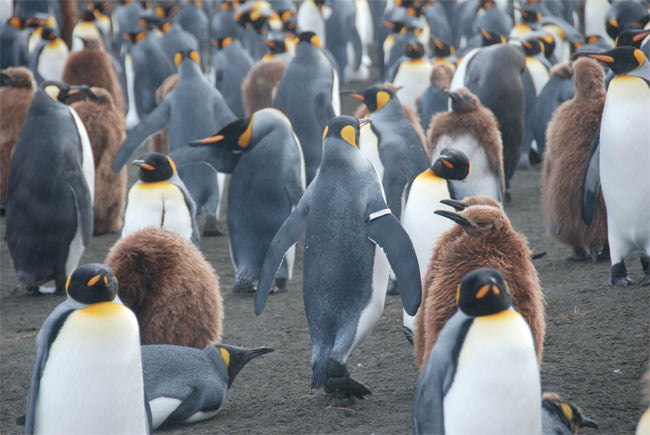
Tracking penguins in Antarctica has given us valuable information about global warming and its affect on Antarctica, but its affects on the penguins are great. Penguins with bands have had less chicks and higher death rates than penguins without these bands. These bands somehow have created less energy for the bird to live and reproduce. Scientist have a theory that the bands create extra baggage and more difficulty when it comes to swimming and catching fish which may have increase mortality rates. Many people now argue that banding penguins is not humane to the penguins and we shouldn't band them in the future. Tragically, if we continue to band penguins, their population will decrease, but if we stop banding penguins, we may sacrifice valuable information.
Sunday, October 17, 2010
Camouflaging Prey
 At first glance, all you see is leaves. Look again. Do you see that? That bird over there? It has to look like a leaf to survive. Survive being eaten by the hawks in our neighborhood. It is prey, nutrients to many, but to survive, it camouflages. But without the tree, the bird will die, but without the bird, the tree will not be affected in any manner, so it is also a form of commensalism. Thanks to its camouflage, this bird lives to see another day
Wednesday, September 29, 2010
Limiting Factors

This is a biotic limiting factor found in our local neighborhood, the bush. This bush is a limiting factor because it limits the amount of sunlight and water that reaches the ground and the other vegetation. It also limits the amount of shelter it can give to bugs and or other animals. But this is not a population due to the fact that it is a single organism not many.
Saturday, May 15, 2010
The Aquarium

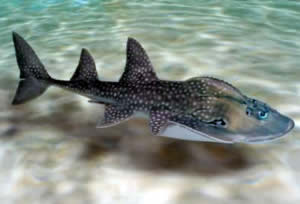
On Friday, our unit went on a field trip to The Camden Aquarium. It was an awesome trip, even though we didn't get to everything. There were touch pools, hippos, seals, penguins and a lot more! The first thing our group did was touch the sharks, that is nurse sharks of course. When a shark started coming my way, I stuck two fingers into the exhibit and felt the flank of the shark. I was surprised, a lot of people said it feels like your ear or it feels like your nose, but actually, it was squishy like your stomach and a little bit course like sand paper. The next shark that came around, i touched its back. That time, it felt more like your ear except a little bit more squishy. We left that exhibit and went outside to go see the seals and penguins. All the penguins were guarding their own little patch of territory. The one penguin that claimed the shower, seemed to have a smile on its face. Next, we went to go see the seals. There was one on top of a rock in the middle of the pond, tanning. As I looked more closely, I realized it had finger nails and toe nails just like humans. Its back was wrinkly and filled with blubber and so was its neck. Every now and then, it would lift up its flipper and rubbed its eye. After that, we saw sharks in the shark tunnel with other fish. I wonder if the fish are scared of the shark. Then we saw hippos. Did you know that birds poop every fifteen minutes? The hippos were sleeping and the fish inside of the tank, were cleaning the hippo. The rest of the day, we saw all kinds of interesting animals such as the shark ray. From underneath, it looked like a stingray from up top, it looked like a shark. I think that the shark ray is the boundaries between the shark and the sting ray, they are both very closely related. The cnidarians we saw were bio luminescent, they would light up. The puffer fish I saw, had a little smile on. It wiggled back and fourth like it was dancing. The field trip was a blast. I learned so much about sea creatures and saw cool animals.
Subscribe to:
Posts (Atom)